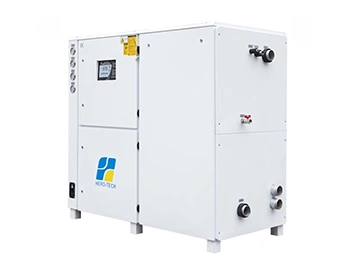
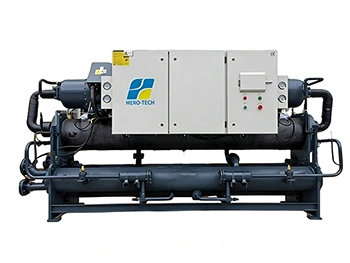
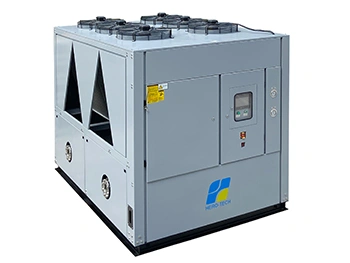
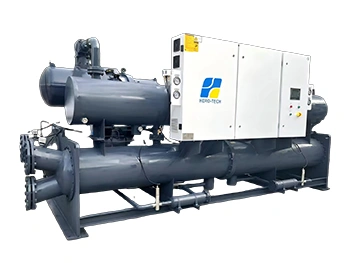
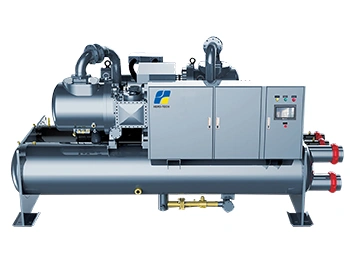
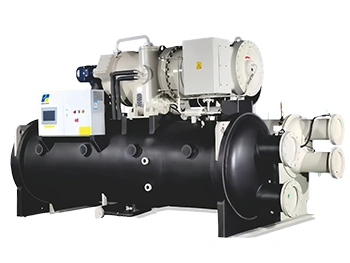
We design and manufacture industrial water chillers, heat pumps and temperature control units for the battery industry
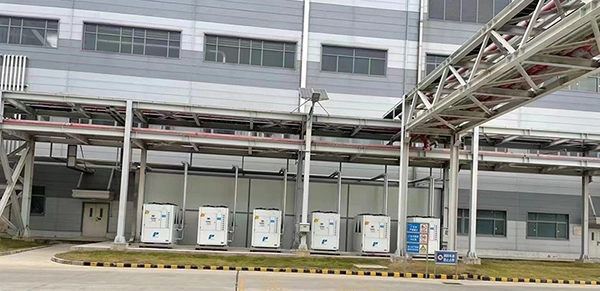
Lithium battery production involves several temperature-sensitive stages, including electrode coating, calendaring, electrolyte filling, and formation. Even slight temperature fluctuations in these processes can compromise material properties, cause electrolyte evaporation, or lead to deformation of the battery structure. Our chillers deliver precise and stable temperature control, keeping each step within its optimal range to ensure consistent product quality, improve yield rates, and maintain production reliability.
- Challenge: The oven temperature in the coating machine must remain steady at 80-120 °C, as the solvent evaporation rate directly affects coating uniformity.
- Solution: A chiller system, such as a 25 HP dual-temperature, dual-control model, provides two-stage cooling:
- Stage 1: 10°C chilled water cools the oven heating system, preventing heat buildup.
- Stage 2: 5°C ice water regulates the temperature of the coating roller surface, eliminating heat stress that can cause electrode sheet warping.
- Result: Coating thickness deviation is reduced from ±3 μm to ±1 μm, and drying efficiency increases by 15%.
Equipment requirement: For an 800-ton calender, the roller surface temperature must be maintained at 40 ± 2 °C during operation.
Technical solution:- Closed-loop chiller system with a cooling capacity of 200 kW
- Built-in microcomputer temperature control module for real-time adjustment of roller cooling water flow
- Equipped with a pressure compensation device to handle dynamic pressure fluctuations between 0.6 and 1.2 MPa
| Parameter | Without Chiller System | With HERO-TECH Chiller Temperature Control |
| Electrode sheet rebound rate | 8.2% | 3.5% |
| Roller surface temperature deviation | ±5℃ | ±0.8℃ |
| Equipment failure rate | 12 times/month | 2 times/month |
Special requirement: During electrolyte filling, the environment must be maintained at 25 ± 1 °C with a dew point of ≤ -40 °C.
System integration:- Air-cooled chiller (outlet water at -15 °C) operating in conjunction with a rotary dehumidifier
- Three-stage heat exchange system:
- Primary cooling: Outdoor unit pre-cools the air to 15 °C
- Deep dehumidification: Lithium chloride rotary wheel adsorbs moisture
- Precision temperature control: Plate heat exchanger adjusts the temperature to the target level
Result: Electrolyte infiltration speed increased by 20%, while moisture content remains consistently below 15 ppm
Q = (P×η)/COP + α×A×ΔT
- Q: Total cooling load (kW)
- P: Equipment motor power (kW)
- η: Heat conversion coefficient (0.85-0.92)
- COP: Coefficient of performance (4.5-6.0 for water-cooled units)
- α: Heat transfer coefficient of building envelope (W/m²·K)
- A: Workshop area (m²)
- ΔT: Indoor–outdoor temperature difference (K)
- Evaporator: Titanium tubes with stainless steel shell, resistant to electrolyte vapor corrosion
- Water circuit: EPDM seals and 316L stainless steel piping, with chloride ion resistance up to ≥ 500 ppm
- Supports Modbus TCP protocol for real-time data exchange with MES systems
- Fault pre-alarm function (e.g., automatic alert when flow deviation exceeds 15%)
- Load balancing algorithm for parallel operation of multiple units
- 12 × 800 RT water-cooled screw chiller units (N+1 redundancy)
- Distributed pump groups with variable frequency control, achieving 35% energy savings
- Smart cloud-based control platform with AI-driven load forecasting
- Annual electricity savings: 120 million kWh
- Product defect rate reduced from 0.8% to 0.23%
- Overall Equipment Effectiveness (OEE) improved to 92.7%